


Chervil Plain
Chervil Plain
Couldn't load pickup availability
- Handmade in the UK
- Crafted from quality materials
- Made to order

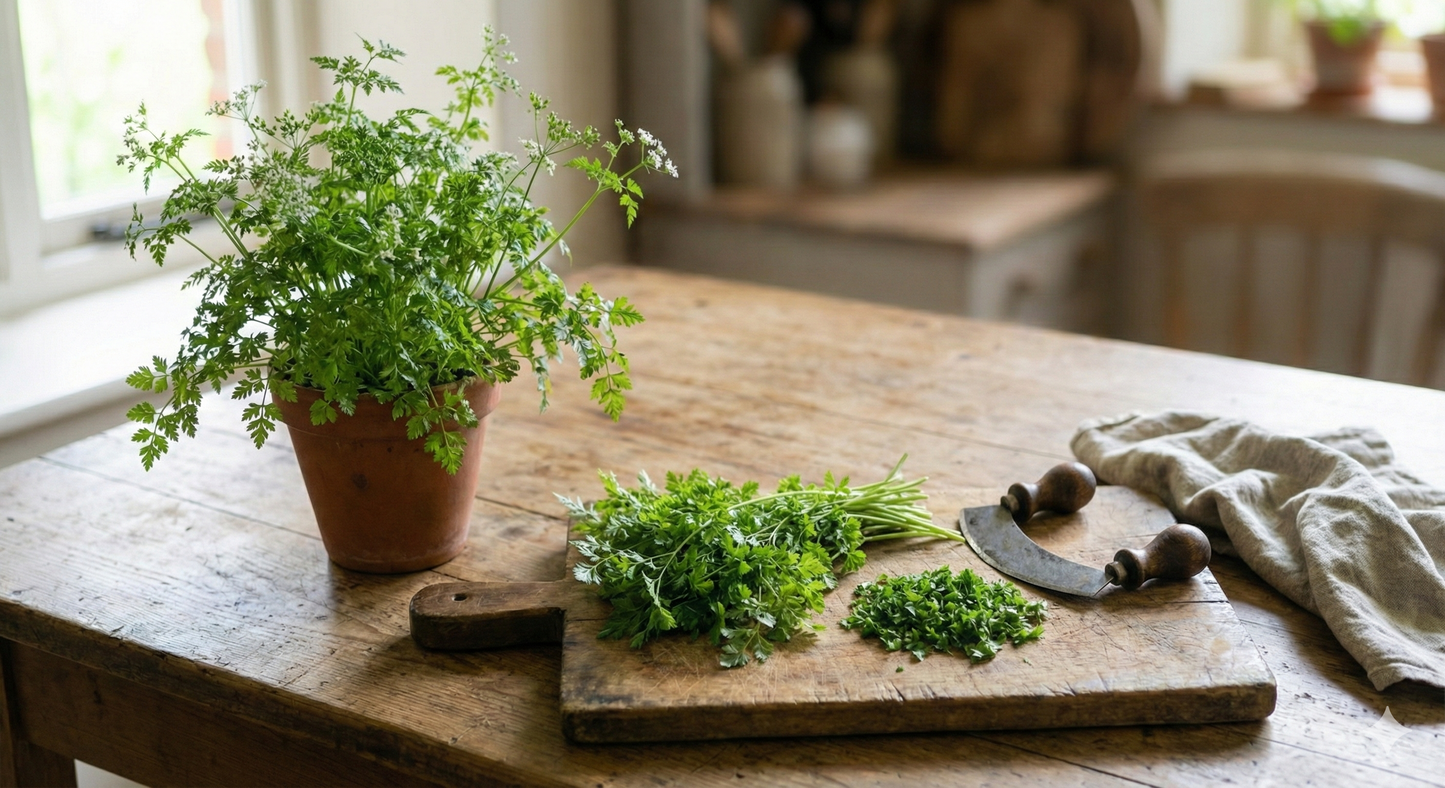
Anthriscus cerefolium 'Plain' The "gourmet parsley" — a refined French herb with a delicate anise sweetness
If parsley is the workhorse of the herb garden, chervil is its quieter, more refined cousin — the herb you reach for when you want a delicate, gourmet finish rather than a robust one. It's one of the four classic French fines herbes — alongside chives, parsley and tarragon — and a defining presence in proper French cooking, where it's finely chopped over omelettes, fish, soft cheeses, salads and sauces just before serving. Sometimes called cerfeuil, French parsley, or "gourmet parsley," chervil has the soft, lacy, fern-like foliage of a more elegant relative of parsley, and a flavour that's both gentler and more interesting — sweetly aromatic, with a quiet anise note somewhere between parsley and tarragon.
It's a herb that rewards the gardener who knows it. Lost on most British kitchens for decades, chervil is having a quiet renaissance amongst home cooks who've discovered just how lovely a fresh handful of finely chopped chervil can be on a simple omelette, in a spring soup, stirred into butter for grilled fish, or tucked into a green salad. The flavour is at its best fresh and at the very end of cooking — chervil's delicate aroma is destroyed by prolonged heat, so it goes on the plate rather than in the pan.
The plant itself is an undemanding hardy annual, growing to around 30 to 60cm tall, with the loveliest bright-green ferny foliage. It's also one of the few culinary herbs that genuinely prefers the cooler months and a bit of shade — which makes it unusually useful for the herb gardener who has a partly shaded corner where lavender and rosemary won't thrive. In hot, sunny conditions it bolts quickly to flower, so the trick is to sow it for cool weather: early spring, and again in late summer for autumn harvests.
A note on growing
Chervil is easy to grow once you understand what it likes — which is to say, what most herbs don't: cooler weather and a bit of shade. It also dislikes being moved (it has a taproot, like most umbellifers), so the best approach is to sow it directly where it's to grow.
Sow direct from March to May, and again from August to September, into a well-prepared seedbed in a partly shaded spot. Press the seeds lightly into the surface and cover with a thin scattering of soil — chervil benefits from a little darkness to germinate, unlike chamomile. Water gently and keep the soil moist. Germination usually takes one to three weeks. Thin the seedlings to about 20cm apart as they establish, eating the thinnings as a peppery salad.
For a continuous supply through the cool months, sow successionally every two to three weeks — the plants are quick to mature and quick to bolt, so a steady rolling sowing is the way to keep a proper kitchen-garden supply going. Don't bother with summer sowings if you can avoid them; in the heat of July and August the plants run to flower in days.
Chervil is genuinely happy in partial shade, which makes it one of the most useful herbs for the gardener with a less-than-perfect aspect. A dappled spot under a light tree, the shaded side of a vegetable bed, or the cool corner where rosemary refuses to settle — chervil will be perfectly content. It also grows beautifully in a deep pot or windowsill trough kept somewhere cool and well-watered.
Water consistently to keep the soil moist; chervil bolts even faster when the soil dries out. Don't feed: like most herbs, lean soil gives the best flavour. Once flowers appear, pull or eat the plant and sow more for the next round.
Where it shines
Chervil is the great herb of finishing. Snip the lacy leaves finely (a small pair of flower snips works beautifully) and scatter them at the last minute over:
- Omelettes and scrambled eggs — a defining classical French pairing, and one of the loveliest uses of chervil
- Soft cheeses and goat's cheese — folded through, or scattered over
- Spring soups — pea, watercress, asparagus, leek and potato all benefit
- Fish — especially the delicate white-fleshed fish like sole, plaice, hake and lemon sole
- Green salads — mixed in whole, or finely chopped into the dressing
- Compound butters — folded into softened butter with lemon and salt, rolled in greaseproof, chilled, and sliced over hot vegetables, fish or grilled chicken
- Sauces — classically Béarnaise, hollandaise, and the French sauce verte
In the garden, chervil is also a quietly useful companion plant — said to improve the flavour of nearby herbs and vegetables (particularly radishes), and to deter slugs and aphids around lettuces. The pretty white umbel flowers, if you let any plants run on to flower, also draw in hoverflies and parasitic wasps that quietly help with pest control.
And it's a herb that simply makes the kitchen garden feel more interesting — the lacy foliage in a partly shaded corner, ready to be snipped over whatever you're cooking at the last moment.
At a glance
- Type: Hardy annual herb (Anthriscus cerefolium) — plain (smooth-leaved) variety
- Height: 30–60cm
- Flavour: delicate, sweetly aromatic, gentle anise note — between parsley and tarragon
- Sow: Direct, March to May and August to September; successional every 2–3 weeks
- Position: Partial shade preferred; cool conditions; moist soil
- Care: Easy if kept cool and moist; bolts quickly in heat; don't feed
- Use: One of the four French fines herbes; chopped fresh at the end of cooking
- Companion: Said to improve nearby radishes; deters some pests
- One of the few herbs that prefers shade — perfect for a less sunny corner
Plant alongside
Chervil is at its best in mixed herb company. Plant alongside French Marigold 'Spanish Brocade' for pollinator and pest support, or Calendula 'Neon' for a cheerful, beneficial-insect-friendly border. Parsley, chives and tarragon are the natural fines herbes partners in a kitchen-garden corner; and chervil pairs well with lettuces and radishes amongst the vegetables.
Material & Sizing
All of our products are handmade in the UK using carefully selected materials, chosen for durability and suitability for their intended use.
All dimensions are approximate and measured externally.
As each item is handmade, minor variations in size and finish may occur.
This does not affect the strength or intended use of the product.
Materials
- Crafted from quality timber or materials appropriate to the product type
- Designed for strength, stability, and everyday use
- Finished with care to ensure a clean, consistent appearance
(Planters are built using timber suited for outdoor use. Non-Outdoor items use untreated materials where appropriate.)
Sizing
- Dimensions are listed on each product page
- Measurements are approximate due to the handmade nature of our products
- If you need a custom size or have specific requirements, bespoke options are available
If you’re unsure which size or product is right for your space, feel free to get in touch before ordering.
If you have any questions before ordering, feel free to get in touch.
Once your order has been dispatched, you’ll receive a confirmation email with tracking details. You can also view your order status anytime by signing in to your customer account.