

Pea Shoots Tendrils
Pea Shoots Tendrils
Couldn't load pickup availability
- Handmade in the UK
- Crafted from quality materials
- Made to order
About this variety
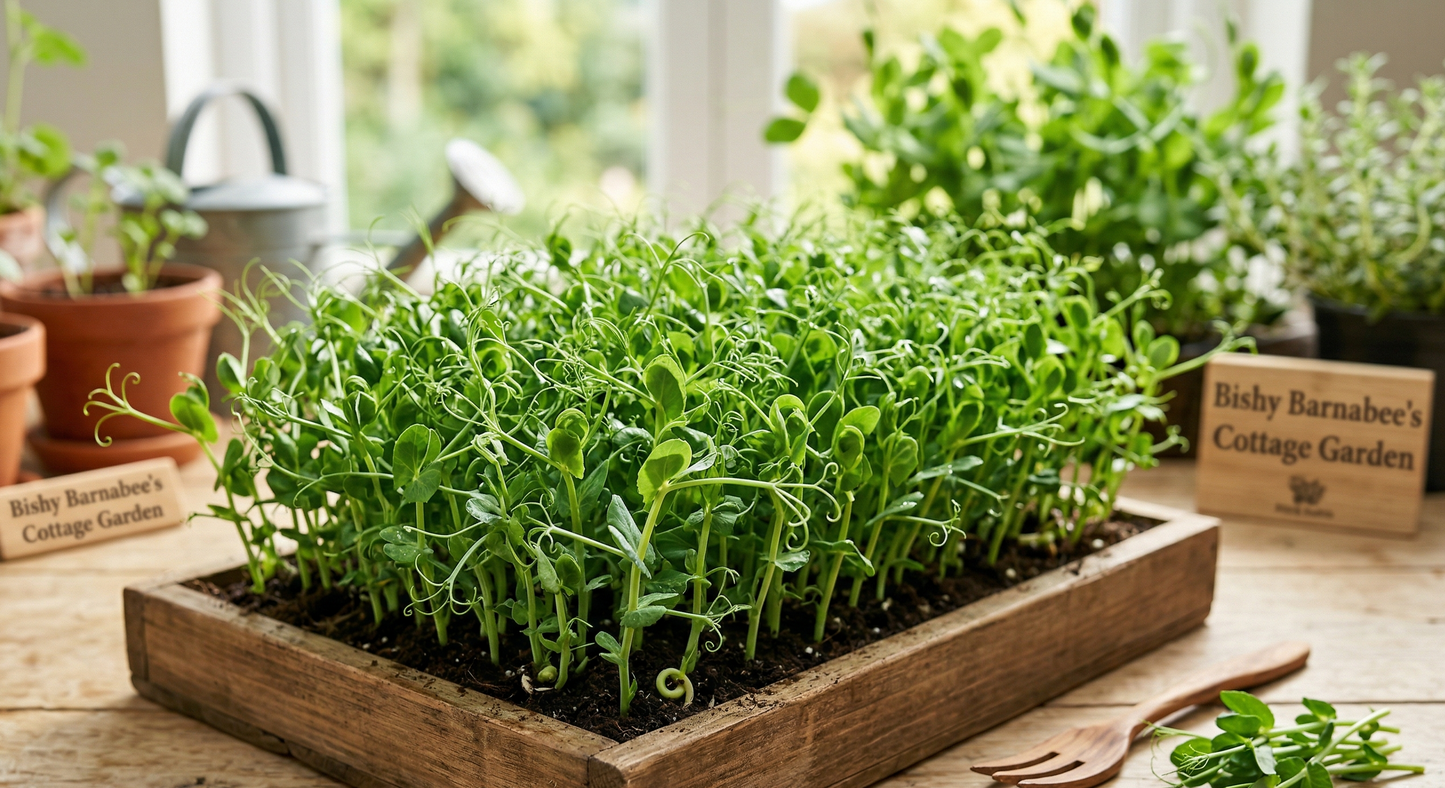
The fastest kitchen-to-table crop with genuine restaurant-quality presence — sweet, crisp, vibrantly green pea shoots with curling tendrils, ready to harvest in ten to fourteen days on any bright windowsill, in any month of the year. The one microgreen that gives you two harvests from a single sowing.
Pea shoot tendrils are a showpiece — the microgreen with the most substantial flavour, the most visually striking form, and the one that appears at premium prices on smart restaurant plates across the country. Grow your own on a kitchen windowsill and you'll have a continuous supply of the sweetest, freshest pea shoots imaginable for a fraction of the shop price, with the added satisfaction of harvesting your own crop from seed to plate in under a fortnight.
Unlike smaller microgreens that sit lightly as a garnish, pea shoot tendrils are a proper edible ingredient in their own right. The curling, intensely pea-flavoured shoots are substantial enough to fill a salad, sturdy enough to stir into stir-fries at the last moment, and elegant enough to garnish the finest plates. They are, quite genuinely, the microgreen that will turn everyday cooking into something a bit special.
🌿 Understanding the Crop
Pisum sativum, the humble garden pea, has been cultivated across Europe and the Middle East for over eight thousand years — among the oldest cultivated crops in human history. When grown as a microgreen for its shoots and tendrils, rather than for pods and peas, the plant delivers a concentrated hit of everything that makes fresh peas so beloved: sweetness, that unmistakable pea flavour, and vibrant green colour, all in a form that can be harvested in a fortnight rather than waiting for a summer harvest.
Why pea shoots are the microgreen chef's choice: Pea shoots are prized in professional kitchens because they combine three qualities that few other microgreens offer together — intense flavour that reads clearly on the plate, substantial texture that holds up in cooking, and the distinctive curling tendrils that give the crop its signature visual character. Where alfalfa or radish microgreens are subtle accents, pea shoots are a proper ingredient.
The two-harvest secret: Unlike any other microgreen, pea shoots regrow after cutting. Leave a 1–2cm stem when harvesting and the plants push out a second flush of shoots within 7–10 days — effectively doubling your yield from a single sowing. Most home growers never realise this and re-sow every batch; those who know the trick keep their trays going for two harvests before starting fresh.
Growing method — tray only: Unlike smaller microgreens such as alfalfa which can be grown in a sprouting jar, pea seeds are too large for the jar method — they need to be sown in a shallow tray of compost or vermiculite to develop the substantial shoots and tendrils that make them worth growing. The tray method is simple and the payoff genuinely rewards the small extra effort.
Year-round growing: Like all microgreens, pea shoots can be grown indoors every month of the year on a warm, bright kitchen windowsill. A minimum temperature of 15–20°C produces the best growth — slightly cooler than the tropical microgreens like alfalfa. A north- or east-facing windowsill actually suits them well, as strong direct sunlight can toughen the shoots. Ideal winter growing.
🌱 Growing Guide
Pea shoots are one of the most satisfying crops in the entire growing world — a genuine harvest in under a fortnight, from a seed the size of a pea, with virtually no risk of failure. The perfect crop for beginners and the crop that never gets old for experienced growers.
Tray method — step by step:
Day 0 (evening): Place your seeds in a bowl of cool water and leave to pre-soak for 6–12 hours — overnight is easiest. Large pea seeds absorb a lot of water and pre-soaking is essential for fast, uniform germination. Skip this step and germination becomes patchy and slow.
Day 1 (morning): Drain the seeds thoroughly. Fill a shallow tray (5–7cm deep) with moist seed compost or vermiculite — aim for damp rather than soggy. Scatter the pre-soaked seeds thickly across the surface, so they cover the compost almost completely in a single dense layer. Press gently into contact with the compost. Cover with a second tray or a sheet of cardboard to exclude light and encourage germination. Keep at 15–20°C.
Days 2–4: Check the tray daily. Once shoots are 2–3cm tall — usually Day 3 or 4 — remove the cover and move to a bright windowsill. Mist twice daily with a spray bottle to keep the surface evenly moist. The shoots will green up rapidly in the first 24 hours after uncovering.
Days 5–14: Continue misting twice daily. The shoots will grow visibly each day. Watch for the distinctive tendrils appearing — the curling wiry growth that gives the crop its name and its restaurant appeal.
Day 10–14: Harvest when the shoots are 8–15cm tall and the tendrils are well-formed. Use sharp scissors to cut just above the soil line, leaving a 1–2cm stem behind for regrowth. Rinse briefly, dry gently, and use straight away for the best flavour.
Second harvest (Days 17–24): Continue misting the cut stems twice daily. Within 7–10 days a second flush of shoots will grow, ready for a second harvest. After the second cut, discard the compost and start a fresh tray — a third harvest is possible but yield drops significantly.
Hygiene:
Fresh seed compost or vermiculite for each new sowing. Rinse trays thoroughly between batches. If any batch develops mould or off smells, discard immediately, clean equipment, and start again with fresh materials. Well-drained compost is the key — standing water causes rot.
📋 Crop Specifications
| Botanical Name | Pisum sativum |
| Common Name | Pea Shoots / Pea Tendrils / Dow Miu (Chinese cuisine) |
| Crop Type | Microgreen / Shoots Crop |
| Family | Fabaceae (legume family) |
| Growing Method | Shallow tray only — jar sprouting not suitable for large seeds |
| Space Required | A shallow tray on a bright windowsill — no garden needed |
| Optimal Temperature | 15–20°C (slightly cooler than alfalfa) |
| Pre-Soak | 6–12 hours in cool water before sowing (essential) |
| Days to Harvest | 10–14 days (first harvest); 7–10 days (second harvest from regrowth) |
| Harvest Period | Year-round — every month of the year, indoors |
| Harvest Size | 8–15cm shoots with curling tendrils |
| Flavour Profile | Sweet, intensely pea-like, crisp texture — the most substantial microgreen flavour |
| Seed Quantity per Tray | Sow densely — approximately 100g per 20cm tray (thick single layer) |
| Available Sizes | 50g packet (approx 2 trays) or 100g packet (approx 4 trays) |
| Perfect For | 🌱 Restaurant-Quality Home Cooking · 🥗 Salads & Stir-Fries · 🍽️ Fine Dining Garnishes · ✂️ Two Harvests Per Sowing · 🏠 Kitchen Windowsill Growing · 🍜 Asian Cuisine (Dow Miu) |
Nutritional Highlights:
- 🟢 Vitamin K — High content; supports bone health and blood clotting
- 🟠 Vitamin C — Fresh living source; immune system support
- 🌾 Folate (Vitamin B9) — Legume family speciality; essential for cell division
- 🔵 Vitamin A (Carotenoids) — From the vibrant green colour; eye and skin health
- 💪 Protein — Legume seeds give pea shoots higher protein than most other microgreens
- ⚪ Iron & Magnesium — Solid mineral content from the seed's reserves
🍽️ Using Your Pea Shoots
Pea shoots are the most versatile microgreen in the entire growing range — substantial enough to be a proper ingredient, delicate enough to be a garnish, and flavoursome enough to work in dishes ranging from simple salads to serious restaurant-quality plates.
Raw — where they shine brightest:
Pea shoots are exceptional raw. Pile them onto sandwiches for a sweet, crunchy fresh note. Toss into salads as the main leaf rather than as a garnish — they hold their own alongside rocket, watercress, and other robust leaves. Layer over avocado toast, smoked salmon, or a soft-boiled egg. Their intense pea flavour comes through even alongside strong ingredients like blue cheese or cured meats.
Stir-fries — the Asian classic:
Dow miu — pea shoots in Chinese cuisine — are a stir-fry classic. Add to a hot wok in the last thirty seconds of cooking, along with a splash of soy sauce and a scattering of sliced garlic. The tendrils wilt slightly but retain their crisp bite, and the pea flavour intensifies briefly in the heat before you plate up. One of the fastest, freshest sides you can cook.
Garnishes — where restaurants use them:
Fine dining kitchens use pea shoots to garnish scallops, seared fish, spring lamb, pea soups, and any dish where a fresh green note and elegant visual character are wanted. The curling tendrils are especially prized visually — they lift a plate into "chef" territory instantly. Try one shoot draped across a plated dish and see how transformative it looks.
Soups & broths:
Pea shoot pesto is a genuinely wonderful spring-through-summer condiment — blend pea shoots with olive oil, lemon juice, garlic, and a hard cheese, then stir through pasta or spoon over grilled vegetables. A handful stirred into a bowl of miso, chicken noodle, or spring vegetable soup at the last moment adds fresh green vitality.
Storing:
Best used within hours of harvest for the sweetest flavour. If storing, wrap gently in a slightly damp piece of kitchen paper and keep in a lidded container in the fridge. They will keep for 2–3 days at their best, up to 5 days if handled carefully. The second harvest from your tray is often preferable to storing the first — genuinely fresh trumps stored, always.
📅 Year-Round Growing Calendar
Sow a fresh tray every 10–14 days for a continuous year-round supply. Remember the second-harvest trick: leave 1–2cm of stem when you cut the first harvest, and a second flush arrives 7–10 days later. One of the very few crops entirely independent of the outdoor growing season.
| Jan | Feb | Mar | Apr | May | Jun | Jul | Aug | Sep | Oct | Nov | Dec | |
|---|---|---|---|---|---|---|---|---|---|---|---|---|
| 🌱 Sow Indoors | ✓ | ✓ | ✓ | ✓ | ✓ | ✓ | ✓ | ✓ | ✓ | ✓ | ✓ | ✓ |
| ✂️ Harvest | ✓ | ✓ | ✓ | ✓ | ✓ | ✓ | ✓ | ✓ | ✓ | ✓ | ✓ | ✓ |
Sow indoors year-round. First harvest 10–14 days after sowing. Second harvest 7–10 days after first cut.
✨ The Rolling Batch & Second Harvest System
Pea shoots offer the most efficient microgreen growing system of any variety in our range. The combination of the rolling batch and the second-harvest trick means one tray effectively becomes two harvests, and staggering trays every 10–14 days gives you a completely uninterrupted supply of fresh pea shoots throughout the year.
How to run the system:
- Tray 1: Sow Day 0, first harvest Day 10–14, second harvest Day 17–24
- Tray 2: Sow Day 10–14 (when Tray 1 first harvest happens), first harvest Day 20–28
- Tray 3: Sow Day 20–28, and so on
Two trays running simultaneously give a household of two an unbroken supply of fresh pea shoots for salads, garnishes, and stir-fries. The 100g packet gives approximately four trays' worth of sowings, or two months of continuous supply with the second-harvest trick.
🏆 Eight thousand years of the humble pea
Pisum sativum is one of the oldest cultivated crops in the entire agricultural history of humanity — grown for its edible seeds across Europe and the Middle East for at least eight thousand years, appearing in Neolithic archaeological sites from Greece to Iran. What we now know as the elegant restaurant garnish is a use of the plant that only recently entered European home cooking, though Asian cuisines have long prized pea shoots as a spring delicacy called dow miu. Growing your own on a kitchen windowsill puts you at the intersection of an ancient crop and a modern culinary trend — and gives you access, year-round, to a flavour and visual character that would otherwise cost restaurant prices for a small handful.
Companions from the Bishy range
- Alfalfa Microgreen Seeds — the natural counterpart. Where pea shoots deliver substantial flavour and texture, alfalfa gives gentle nutritional density. Grow both on the same windowsill for variety across the week
- Other microgreen seeds — radish, broccoli, mustard, sunflower and more. Rotating variety on the windowsill gives you a proper daily microgreen habit
- Herb seeds — basil, coriander, parsley and chives grow beautifully alongside microgreens on the kitchen windowsill
- Pea seeds for outdoor growing — if you love the shoots, consider growing the full pea crop outdoors for peas in the pod. Different variety selection but the same species
- GroZone Perfect Propagator — provides consistent warmth and moisture for optimal germination. Excellent for pea shoots and all other microgreens
- GroZone Potting Tidy Tray — the contained potting station for filling trays and keeping your microgreen workflow tidy
Material & Sizing
All of our products are handmade in the UK using carefully selected materials, chosen for durability and suitability for their intended use.
All dimensions are approximate and measured externally.
As each item is handmade, minor variations in size and finish may occur.
This does not affect the strength or intended use of the product.
Materials
- Crafted from quality timber or materials appropriate to the product type
- Designed for strength, stability, and everyday use
- Finished with care to ensure a clean, consistent appearance
(Planters are built using timber suited for outdoor use. Non-Outdoor items use untreated materials where appropriate.)
Sizing
- Dimensions are listed on each product page
- Measurements are approximate due to the handmade nature of our products
- If you need a custom size or have specific requirements, bespoke options are available
If you’re unsure which size or product is right for your space, feel free to get in touch before ordering.
If you have any questions before ordering, feel free to get in touch.
Once your order has been dispatched, you’ll receive a confirmation email with tracking details. You can also view your order status anytime by signing in to your customer account.