

Radish China Rose
Radish China Rose
Couldn't load pickup availability
- Handmade in the UK
- Crafted from quality materials
- Made to order
About this variety
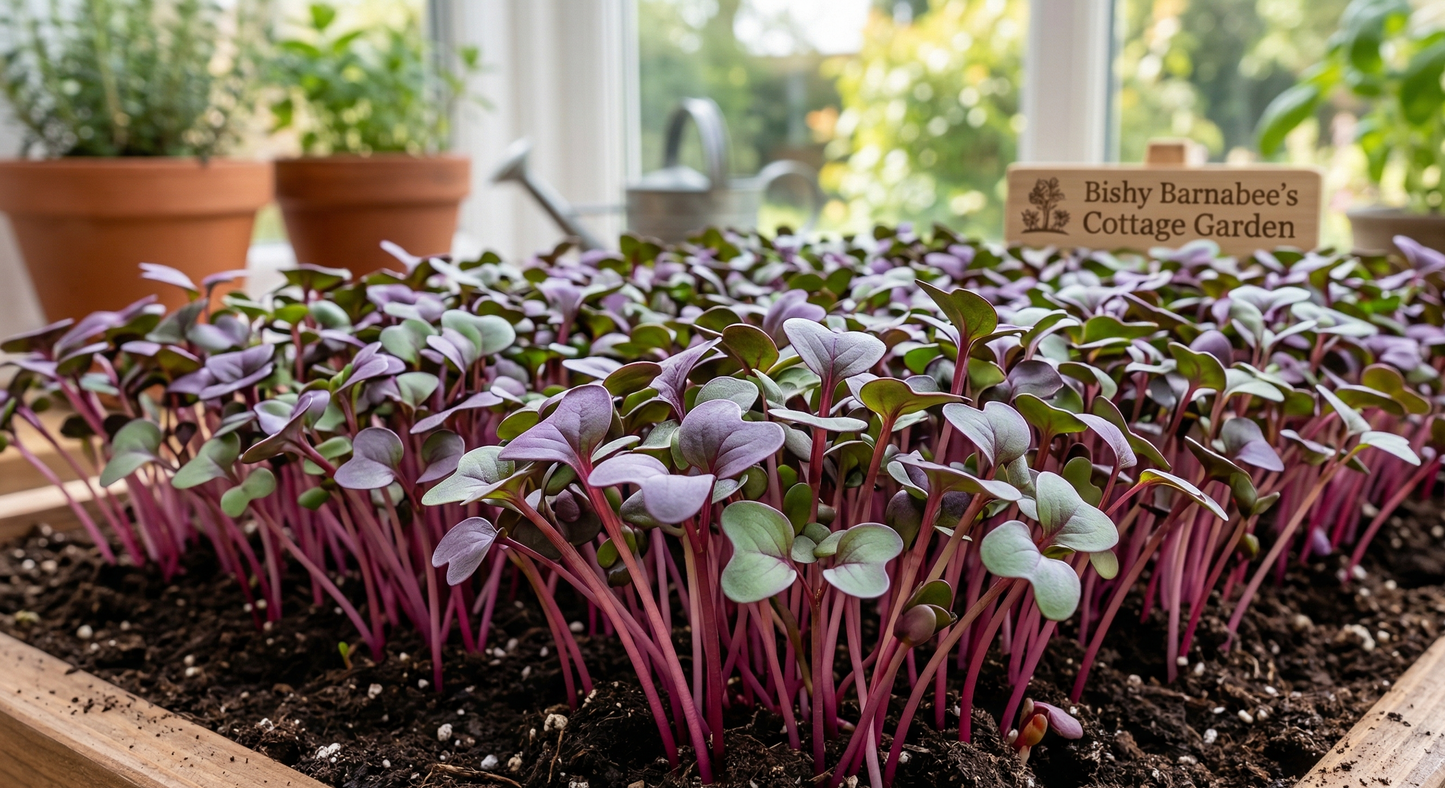
The elegant heritage radish microgreen — long, blush-pink stems and vivid green leaves with a crisp, refined peppery warmth that is gentler and more sophisticated than Rambo. A Victorian kitchen garden variety that looks as beautiful in a tray as it does on a plate.
China Rose is one of those quiet classics of the kitchen garden — a Chinese radish variety introduced to European gardens in the nineteenth century, popular with Victorian gardeners for its long white root and pink skin, and now enjoying an entirely new life as one of the finest microgreens for elegant plating. Where Rambo is dramatic and modern, China Rose is refined and heritage. Where Rambo shouts, China Rose whispers. Both are radish microgreens, both are peppery, both are anthocyanin-rich — but they serve genuinely different purposes on the plate and complement each other rather than compete.
The visual signature is the blush-pink stem — not the deep, dense purple of Rambo but a softer, rose-pink shade that reads as elegant rather than dramatic. The stems grow long and upright, the leaves emerge vivid green, and the finished microgreen has the poised, refined character that fine dining kitchens have prized for decades. If Rambo is the bold splash of colour, China Rose is the considered accent that lifts a plate into "restaurant" territory without ever asking for attention.
🌿 Understanding the Crop
Raphanus sativus ‘China Rose’ is an heirloom radish cultivar with a long history in both Chinese and European kitchen gardens. Introduced to Western horticulture in the mid-nineteenth century, it became a Victorian favourite for its long, elegant white root with distinctive rose-pink skin — a variety grown both for late-season eating and for winter storage. As a microgreen it delivers the same visual elegance in a fraction of the time, with the anthocyanin-rich pink stems developing rapidly once the seedlings are exposed to light.
Heritage vs modern — the two radish microgreens compared:
Bishy stocks both China Rose and Rambo radish microgreens because they serve different purposes on the plate. China Rose is the heritage choice: gentler colour, gentler flavour, longer more elegant stems. Rambo is the modern choice: maximum colour, maximum flavour intensity, dense and dramatic. Both grow in the same way, both are grown in seven to ten days, both add anthocyanin nutrition — but a chef choosing between them is choosing between refined restraint and confident drama. Serious kitchens often stock both for different applications.
The Victorian kitchen garden context: China Rose was one of the most popular radish varieties in Victorian British walled gardens — a variety head gardeners of large estates would sow in succession from spring through autumn, storing the mature roots through winter for the table. That the same variety now serves as an elegant microgreen for professional kitchens brings the plant full circle: two centuries after its introduction, China Rose has found a second act on the modern restaurant plate.
The anthocyanin story: Like Rambo, the pink colouration in China Rose comes from anthocyanins — the same class of powerful plant antioxidants that colour blackcurrants and red cabbage. The pink is less intense than Rambo's deep purple because the variety produces anthocyanins at a lower concentration, but the pigments are the same and the nutritional benefit is present in every mouthful. Not quite the concentrated hit of Rambo, but a genuine functional food ingredient nonetheless.
Growing method — tray only, no pre-soak needed: Like Rambo and Rocket, China Rose seeds are the perfect size for direct sowing without pre-soaking. Sow onto damp compost or vermiculite in a shallow tray, cover for darkness for the first two to three days, then move to bright light immediately for pink colour development.
The light-for-pink rule: As with Rambo, the intensity of China Rose's pink colouration depends on light exposure. Cover for darkness during germination (2-3 days) to encourage strong stem elongation, then uncover and move to bright light immediately. The pink develops within 24 hours of light exposure and deepens over the following days. Weak light produces pale, almost white stems; bright light produces the vivid rose-pink that gives China Rose its plating value.
Year-round growing: Like all microgreens, China Rose can be grown indoors every month of the year on a warm, bright kitchen windowsill. A minimum temperature of 18–22°C produces the fastest germination. Bright indirect light suits China Rose particularly well — enough light to develop the pink stems, without so much that the shoots toughen up.
🌱 Growing Guide
China Rose is a beautifully reliable microgreen for beginners and experienced growers alike — simple direct sowing, quick germination, dependable colour, and a finished crop that genuinely rewards the small effort involved.
Tray method — step by step:
Day 0 (sowing day): Fill a shallow tray (5–7cm deep) with moist seed compost or vermiculite. Aim for damp rather than soggy — well-drained is essential. Scatter China Rose seeds thickly across the surface in a single dense layer, so the seeds almost touch. Press gently into contact with the compost. Do not pre-soak — direct sowing is correct for this variety.
Days 1–3: Cover with a second tray or a sheet of cardboard to exclude light. Keep at 18–22°C. Do not water during this phase unless the compost is drying out at the surface. Darkness triggers strong stem elongation — the shoots emerge tall and reaching for light that isn't there.
Day 3 or 4: When shoots are 2–3cm tall, remove the cover and move to a bright windowsill. The stems will be pale ivory at this point; within 24 hours of light exposure the rose-pink colouration develops. Mist twice daily with a spray bottle to keep the surface evenly moist.
Days 4–10: Continue misting twice daily. The pink deepens through pale rose to fuller blush over the following days. The vivid green leaves develop rapidly once fully exposed to light.
Day 7–10 (harvest): Harvest when the shoots are approximately 6–8cm tall and the seed leaves are fully open and green. Use sharp scissors to cut just above the soil line. Rinse briefly, dry gently, and use immediately for the best flavour and colour. China Rose does not regrow after cutting — discard the compost and start a fresh tray for the next batch.
⚠️ Important: White root hairs are normal, not mould
During the first few days of germination, tiny white hairs often appear on and around the roots of radish microgreens including China Rose. These are root hairs — a natural and desirable feature of healthy germination that helps the seedlings absorb water. They are not mould, and they are not a sign of anything wrong. True mould is fuzzy, grey or greenish, and typically has an off smell; root hairs are fine, white, and always associated directly with the developing roots. If in doubt, mist gently rather than rinsing — disturbing the root hairs unnecessarily can affect the seedling's ability to absorb water.
Hygiene:
Fresh seed compost or vermiculite for each new sowing. Rinse trays thoroughly between batches. Standing water causes rot — ensure trays drain freely. If any batch develops actual mould (fuzzy, grey/green, off-smelling) or shoots collapse, discard immediately, clean equipment, and start again with fresh materials.
📋 Crop Specifications
| Botanical Name | Raphanus sativus ‘China Rose’ |
| Common Name | China Rose Radish / Pink Radish Microgreen |
| Variety Type | Heirloom / Heritage cultivar (Victorian kitchen garden classic) |
| Crop Type | Microgreen |
| Family | Brassicaceae (mustard family) |
| Growing Method | Shallow tray of compost or vermiculite — no pre-soaking required |
| Space Required | A shallow tray on a bright windowsill — no garden needed |
| Optimal Temperature | 18–22°C |
| Pre-Soak | Not required — direct sow onto damp compost |
| Days to Harvest | 7–10 days from sowing |
| Harvest Period | Year-round — every month of the year, indoors |
| Harvest Size | 6–8cm shoots with elegant blush-pink stems and vivid green leaves |
| Colour | Blush/rose-pink stems, vivid green cotyledons — refined and elegant |
| Flavour Profile | Gentle peppery warmth — refined and considered, softer than Rambo |
| Regrowth | Single harvest only — does not regrow after cutting |
| Seed Quantity per Tray | Sow densely — approximately 15–25g per 20cm tray |
| Available Sizes | 50g packet (approx 2–3 trays) or 100g packet (approx 4–6 trays) |
| Perfect For | 🌸 Elegant Plate Garnishing · 🍽️ Fine Dining Presentation · 💗 Refined Colour Accent · 🌿 Heritage Variety Growing · 🏠 Year-Round Windowsill Growing · 🥗 Salads & Delicate Dishes |
Nutritional Highlights:
- 💗 Anthocyanins — The pink pigment itself; powerful antioxidants for cardiovascular and cognitive health
- 🟠 Vitamin C — Fresh living source; immune system support
- 🟢 Vitamin K — Supports bone health and blood clotting
- 🔵 B Vitamins (including B6) — Energy metabolism and nervous system health
- ☀️ Vitamin A (as beta-carotene) — Eye and skin health
- 🌟 Vitamin E — Cellular protection and skin health
- ⚪ Iron, Calcium & Magnesium — Solid mineral content from the seed's reserves
🍽️ Using Your China Rose Microgreens
China Rose is the microgreen for the elegant plate — the finishing touch that reads as considered rather than dramatic, refined rather than showy. Think of it as the horticultural equivalent of a discreet piece of good jewellery: it doesn't announce itself, but everyone notices.
Refined plate garnishing:
A few China Rose shoots draped or scattered across a plate lifts the entire presentation into "considered" territory. Excellent on scallops, poached fish, delicate risottos, elegant salads — anywhere you want a fresh green note and a soft pink accent without dominating the dish. The long, elegant stems photograph beautifully and hold their shape on the plate.
Delicate salads:
Where Rambo brings drama to a salad and Rocket brings substance, China Rose brings elegance. Ideal for the composed salad, the pretty starter, the dish that wants restraint rather than intensity. Pair with butterhead lettuce, cucumber ribbons, edible flowers, and a light citrus vinaigrette for a salad that feels considered rather than casual.
Sandwiches and toast:
Adds a delicate peppery note and pink visual accent to open sandwiches, canapés, and elegant toast. Excellent with cream cheese, smoked salmon, cucumber, avocado — classic delicate ingredients that suit the microgreen's refined character rather than overpowering it.
Sushi and Japanese dishes:
The elegant form and gentle flavour make China Rose particularly welcome in Japanese cuisine, where refined presentation matters as much as flavour. Excellent on sashimi, nigiri, poke bowls, and rice bowls — the pink stems reading beautifully against dark seaweed and white rice.
Cheese boards and canapés:
A small pile of China Rose alongside a proper cheese selection looks and tastes right — the pepper cuts through richness, the pink colour lifts the visual presentation, and the elegance suits the occasion. Also excellent scattered over goat's cheese canapés, fig and honey combinations, or delicate pâtés.
Choosing between China Rose and Rambo for a specific dish:
- Use China Rose when the dish is refined, the presentation matters, restraint is called for, and gentle pepper suits the flavour balance
- Use Rambo when the dish is dramatic, colour matters most, punchy flavour is welcome, and visual drama is the point
- Use both together when you want the full radish microgreen spectrum on one plate — pink and purple, refined and dramatic, gentle and intense
Storing:
Best used within hours of harvest for the freshest colour and flavour. If storing, wrap gently in slightly damp kitchen paper and keep in a lidded container in the fridge. China Rose keeps 2–3 days at best condition, up to 5 days with some quality loss. As with all microgreens, fresh harvest always beats stored — rolling batches maintain a supply.
📅 Year-Round Growing Calendar
Sow a fresh tray every 7–10 days for a continuous year-round supply. Because China Rose does not regrow after cutting, the rolling batch system is essential rather than optional. Two trays running simultaneously give a household of two an unbroken flow of elegant pink-stemmed shoots.
| Jan | Feb | Mar | Apr | May | Jun | Jul | Aug | Sep | Oct | Nov | Dec | |
|---|---|---|---|---|---|---|---|---|---|---|---|---|
| 🌱 Sow Indoors | ✓ | ✓ | ✓ | ✓ | ✓ | ✓ | ✓ | ✓ | ✓ | ✓ | ✓ | ✓ |
| ✂️ Harvest | ✓ | ✓ | ✓ | ✓ | ✓ | ✓ | ✓ | ✓ | ✓ | ✓ | ✓ | ✓ |
Sow indoors year-round. Harvest 7–10 days after sowing. Sow a new tray every 7–10 days for continuous supply.
✨ The Elegant Plating Tip
China Rose is at its most beautiful used sparingly and thoughtfully. Rather than piling shoots onto a plate, drape three or four across a finished dish — the long pink stems and green leaves creating a considered composition rather than a scattered garnish. Cut with sharp scissors just before serving; the shoots wilt slightly if left prepared for too long, and the whole point of home-grown microgreens is that they can be used at their absolute freshest. For the finest plating, arrange the shoots pointing the same direction rather than randomly — a small detail that reads as restaurant-standard presentation.
🏆 The Victorian kitchen garden classic reborn
China Rose has been part of British and European gardens since the mid-nineteenth century — a Chinese radish variety brought westward by Victorian plant enthusiasts and quickly adopted into the walled kitchen gardens of large estates. For over a hundred and fifty years it was known and grown primarily as a full-crop radish, its long white root with distinctive pink skin appearing on autumn and winter tables across Britain. Its second act as a microgreen has emerged only in recent decades, but the same qualities that made it a Victorian favourite — reliable germination, elegant colour, refined flavour — make it exceptional in this new form. When you grow China Rose today, you're growing a variety with continuous cultivation history in British gardens for over a century and a half, brought to the freshest possible expression by the fact that your harvest happens on your own kitchen windowsill.
Companions from the Bishy range
- Radish Rambo Microgreen Seeds — the modern dramatic sister. Together the two radish microgreens cover the full spectrum: China Rose for elegance, Rambo for drama; pink and purple; refined and intense. Serious kitchens keep both
- Rocket Sprouting Seeds — the third brassica. Peppery-nutty character complements China Rose's gentler pepper. Together for a salad with three-way brassica flavour
- Common Cress — the sharp-bright brassica classic. Cress's volatile pepper against China Rose's refined warmth creates genuinely different flavour experiences
- Alfalfa Microgreen Seeds — the mild counterpart. Alfalfa's gentle green base with China Rose scattered on top makes an elegant salad
- Pea Shoots Tendrils — the sweet counterpart. Substantial pea shoot base with elegant China Rose garnish on top
- Other microgreen seeds — broccoli, mustard, sunflower and more. Rotating variety on the windowsill gives you a proper daily microgreen habit
- Full-grown radish seeds — if you love China Rose as a microgreen, consider growing the full crop outdoors for winter storage radishes
- GroZone Perfect Propagator — consistent warmth and moisture for reliable germination
- GroZone Potting Tidy Tray — contained potting station for tray sowings
📖 Want more detailed growing advice?
Read our complete China Rose growing guide →
Material & Sizing
All of our products are handmade in the UK using carefully selected materials, chosen for durability and suitability for their intended use.
All dimensions are approximate and measured externally.
As each item is handmade, minor variations in size and finish may occur.
This does not affect the strength or intended use of the product.
Materials
- Crafted from quality timber or materials appropriate to the product type
- Designed for strength, stability, and everyday use
- Finished with care to ensure a clean, consistent appearance
(Planters are built using timber suited for outdoor use. Non-Outdoor items use untreated materials where appropriate.)
Sizing
- Dimensions are listed on each product page
- Measurements are approximate due to the handmade nature of our products
- If you need a custom size or have specific requirements, bespoke options are available
If you’re unsure which size or product is right for your space, feel free to get in touch before ordering.
If you have any questions before ordering, feel free to get in touch.
Once your order has been dispatched, you’ll receive a confirmation email with tracking details. You can also view your order status anytime by signing in to your customer account.